


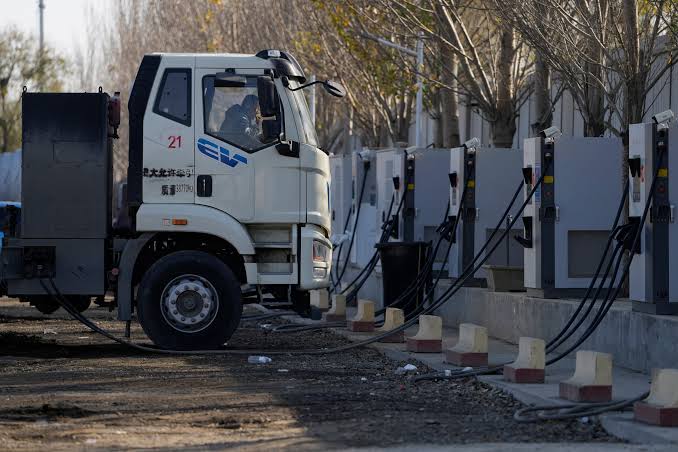
BEIJING (Autos & Transportation Desk): China’s electric truck manufacturers are rapidly expanding their presence across Asia as soaring diesel prices following the Iran conflict push transport companies to accelerate the switch to battery-powered commercial vehicles.
The trend has fueled a sharp rise in China’s electric truck exports while reinforcing strong domestic demand, helping the world’s largest automotive market reduce its exposure to volatile fuel prices.
Data shows that China exported 16,823 heavy electric trucks during the four months following the outbreak of the conflict on February 28, more than twice the volume recorded during the same period a year earlier. Around half of those shipments were destined for South and Southeast Asian markets. Exports to South Asia increased more than fivefold, while deliveries to Southeast Asia nearly tripled.
The shift comes as countries across these regions, which rely heavily on Middle Eastern crude oil, face steep increases in diesel prices after Iran closed the Strait of Hormuz. According to GlobalPetrolPrices.com, diesel prices have climbed 48% in Sri Lanka and 57% in the Philippines since the conflict began. In comparison, official data shows diesel prices in China have risen by about 15%.
The sharp rise in fuel costs has strengthened the business case for electric heavy-duty vehicles, particularly in freight transport where fuel accounts for a significant share of operating expenses.
“The war has opened the door to these new markets,” said Zhaoting Yue, Vice President of International Marketing at Sany, the world’s largest manufacturer of electric heavy trucks.
Although overseas shipments remain modest compared with China’s massive exports of passenger vehicles and motorcycles, industry executives believe sustained growth could significantly reduce diesel consumption and lower carbon emissions if adoption follows China’s domestic trajectory.
China’s electric truck market has expanded at remarkable speed. From virtually no presence in 2021, electric models accounted for roughly 30% of truck sales last year. During the first half of this year alone, approximately 140,000 electric trucks were sold, while the country’s diesel consumption began declining last year.
Sany, which previously concentrated on European markets, is now shifting its international strategy toward Southeast Asia while developing more affordable electric truck models tailored to emerging economies. In June, the company delivered its largest single export order of 880 heavy electric trucks, although Yue declined to identify the customer because the agreement remains confidential.
“Before oil prices rose, buyers in these countries might have needed 28 months to recoup their investment in an electric heavy truck,” Yue said. “Now, it takes only 18 months.”
The company expects strong demand to continue for at least another year, with Asia, Africa and Latin America emerging as key growth markets.
While electric delivery vans have become increasingly common in Europe and the United States, adoption of larger battery-powered trucks has progressed much more slowly. Tesla, for example, has postponed its earlier target of reaching volume production of its Semi truck by this year.
According to the Centre for Research on Energy and Clean Air (CREA), China’s expanding electric truck fleet is expected to save the equivalent of 141 million barrels of oil this year—more than 3% of the country’s total oil consumption and roughly equal to the volume it imports from Kuwait.
Despite the momentum, challenges remain. Higher upfront purchase costs and limited charging infrastructure continue to slow adoption in many markets.
In Australia, an electric truck costs about A$500,000 (US$350,000), roughly twice the price of a comparable diesel vehicle. However, Daniel Bleakley, co-founder of electric trucking company New Energy Transport, said lower fuel expenses can reduce operating costs by as much as 70%, allowing operators to recover the higher purchase price over time.
To address charging concerns, Sany has begun offering customers integrated systems that generate electricity, store energy and provide charging capabilities alongside its vehicles.
CREA co-founder Lauri Myllyvirta believes the rapid expansion of Chinese electric passenger cars abroad will also accelerate the development of charging infrastructure, making it easier for commercial truck operators to transition to electric fleets.
“High fuel prices are going to focus minds and get businesses to move fast,” he said.