


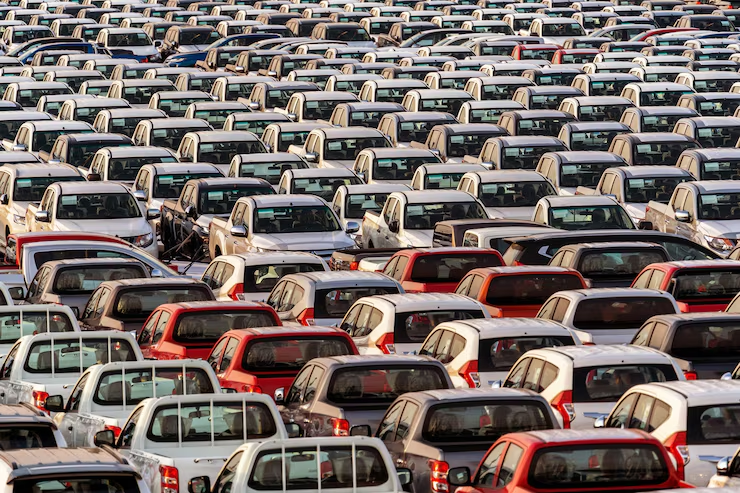
SHANGHAI (Autos & Transport Desk): China’s automotive industry is strengthening its presence in international markets at a remarkable pace, gaining ground across Europe, Southeast Asia and other regions as domestic sales continue to weaken. The shift is placing increasing pressure on established global manufacturers such as Toyota Motor and Volkswagen, which are facing growing competition from China’s expanding lineup of affordable, technology-focused vehicles.
While leading Chinese manufacturers including BYD, Geely and Chery have long pursued global ambitions, industry analysts say overseas expansion has evolved from a growth strategy into a business necessity. Sluggish demand at home, combined with years of intense price competition, has left the country’s auto sector with significant excess manufacturing capacity.
As a result, Chinese carmakers are relying more heavily on international markets to sustain production and maintain growth. Their aggressive export push is expected to further challenge European and Japanese rivals already struggling to compete against China’s low-cost electric vehicles equipped with advanced technology.
Bill Russo, chief executive of Shanghai-based advisory firm Automobility, said Chinese manufacturers possess excess production capacity, highly competitive supply chains and increasingly sophisticated products, giving them a strong commercial incentive to seek growth beyond China’s borders.
He added that expanding internationally is becoming a strategic necessity for the country’s leading automakers.
The latest industry data highlights the widening gap between domestic performance and export growth. Vehicle sales in China dropped 20% year-on-year to 1.47 million units in July, marking the market’s tenth consecutive month of decline. During the same period, exports climbed 88% to 923,000 vehicles.
Although export figures include foreign brands manufactured in China, domestic automakers are also experiencing the same broad trend of shrinking sales at home alongside strong export growth.
Cui Dongshu, head of the China Passenger Car Association, attributed July’s domestic slowdown to elevated fuel prices, which have weakened demand for gasoline-powered vehicles, as well as continuing softness in the entry-level sedan market.
The auto industry’s performance mirrors broader economic conditions in China, where strong industrial production and exports continue to support economic growth while a prolonged property market downturn and subdued consumer spending weigh on domestic demand. Policymakers are grappling with an economy capable of producing more goods than consumers are purchasing at home, making overseas markets increasingly important for manufacturers.
The scale of the domestic slowdown has been significant. During the first half of 2026, China’s domestic vehicle sales fell by 2.3 million units compared with the same period a year earlier—a decline of 20%.
That reduction is roughly equivalent to the total number of new passenger vehicle registrations recorded in Japan, the world’s fourth-largest automobile market, during the same six-month period. Meanwhile, Chinese vehicle exports increased 71% in the first half of the year.
HSBC analyst Yuqian Ding expects domestic demand to stabilize and potentially begin recovering between late August and September as new vehicle launches gather momentum. However, she said a rapid V-shaped recovery remains unlikely.
BYD illustrates how overseas expansion is helping offset domestic weakness. The company recorded a 35% decline in sales within China during the first seven months of 2026, while its overseas sales surged 79% from a year earlier. Brazil and Britain have become BYD’s largest individual international markets outside China this year.
China’s growing influence in global vehicle exports is also reshaping competition with Japan. Since 2023, China has held the position of the world’s largest vehicle exporter, ending Japan’s long-standing leadership in the category.
According to Russo, Japan built its automotive export success on manufacturing efficiency, quality and fuel economy. China’s competitive strengths today extend beyond those advantages to include electrification, battery technology, software integration, intelligent vehicle features, large-scale supply chains and exceptionally fast product development.
He said that combination has the potential to make China’s global expansion significantly more disruptive for the established automotive industry.
Also read: Hyundai Russia auto factory buyback option nears expiry amid ongoing constraints