


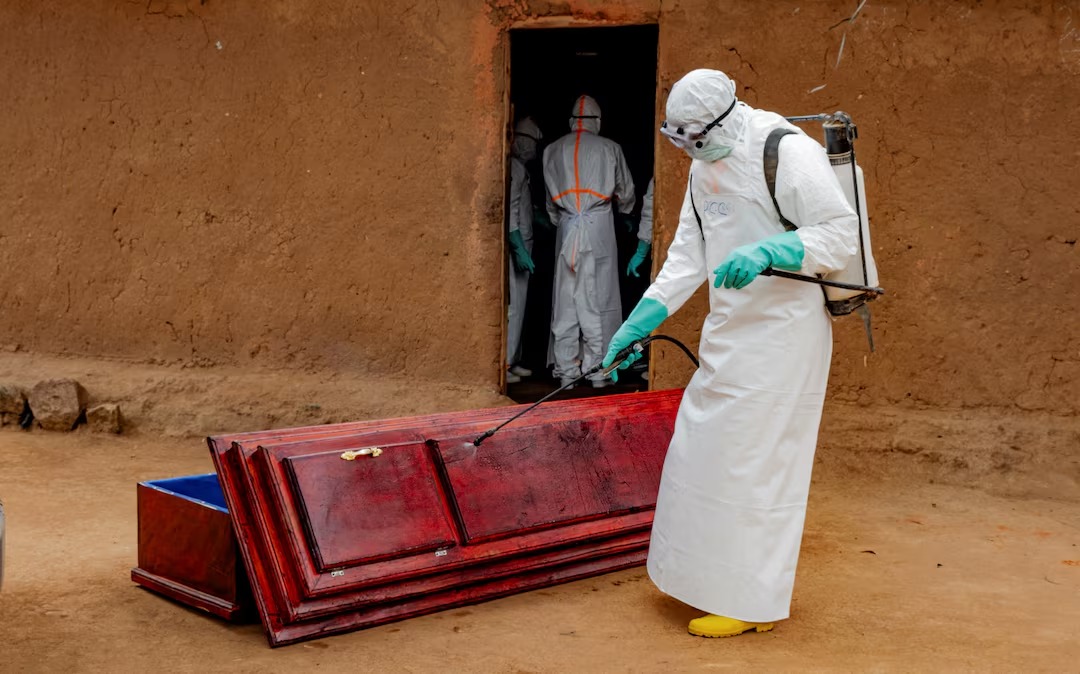
The Democratic Republic of Congo is facing growing pressure to expand its response to an Ebola outbreak as shortages of trained health workers, operational partners and funding limit efforts to increase treatment capacity, according to the World Health Organization.
The outbreak, caused by the Bundibugyo species of Ebola, has expanded beyond its initial epicentre in Bunia and now affects six provinces in the country’s northeast. In response, authorities have moved toward a more decentralised approach, establishing treatment centres closer to communities where new infections have been reported.
WHO technical officer Luca Fontana said the response had already undergone a rapid expansion, with nearly 1,400 treatment beds established across 59 treatment centres. He described the scale-up as one of the fastest he had witnessed, including in comparison with the 2014-2016 Ebola epidemic in West Africa.
“Yet, despite this extraordinary effort, we estimate that another 1,600 beds will be required,” Fontana said.
The WHO estimates that approximately three health workers are needed for every Ebola treatment bed. Reaching a planned capacity of 3,000 beds would therefore require about 9,000 health workers, including roughly 5,000 additional personnel who would need to be recruited and trained.
The expansion is also being constrained by the limited number of international organisations with the capacity to operate Ebola treatment centres. Fontana said the situation had been compounded by wider reductions in global donor funding, further narrowing the resources available for the response.
According to the WHO, the outbreak has now surpassed 6,000 reported cases and 3,175 deaths, making it the country’s worst Ebola epidemic as infections continue to spread across northeastern Congo.