


BRASILIA/SAO PAULO, Sept 10 — As Brazil heads toward its October 4 presidential election, Supreme Court Justice Andre Mendonca has emerged as an increasingly influential figure in the political struggle surrounding President Luiz Inacio Lula da Silva and right-wing challenger Flavio Bolsonaro.
Thousands of supporters gathered in Sao Paulo on Monday for a rally backing Bolsonaro, but a giant balloon portraying Mendonca drew unusual attention. The justice was not present at the event, yet his image reflected his growing popularity among Brazil’s political right.
The rally’s emcee invoked Mendonca during the event, calling on the crowd to pray the Lord’s Prayer for the justice, whom he described as courageous and bold.
Mendonca, the Supreme Court’s only openly evangelical justice, has increasingly found himself at the center of disputes that carry significant political consequences. On Tuesday, he ordered the suspension of Brazil’s federal police chief after the official circulated an intelligence report containing unproven allegations concerning the justice.
The decision further intensified a confrontation between branches of Brazil’s justice system at a particularly sensitive point in the election campaign. Polling has indicated a closely fought contest between Lula and Bolsonaro, with the next president potentially gaining the opportunity to appoint at least three of the Supreme Court’s 11 justices.
That prospect gives the election consequences that extend well beyond the presidency, potentially altering the court’s ideological balance for years.
Mendonca was appointed to the Supreme Court in 2021 by former President Jair Bolsonaro and has since become an important voice within an increasingly conservative group of justices whose decisions have frequently conflicted with the Lula administration.
Four officials familiar with the Supreme Court, Federal Police and prosecutor general’s office, all critical of Mendonca, expressed concern that his recent actions could form part of a broader effort to weaken Lula politically while pushing the Supreme Court closer to Brazil’s growing conservative movement.
Two allies of Mendonca, speaking anonymously because they were not authorized to comment publicly, rejected that interpretation and portrayed him as an independent judge.
The dispute escalated again on Wednesday when Justice Flavio Dino, appointed by Lula, issued a ruling restoring the suspended federal police chief to his position. The move could ultimately require the full Supreme Court to resolve the disagreement.
Without directly naming Mendonca, Dino warned that judicial actions should not become tools that can be used to support political advertising, rallies, campaign events or other forms of partisan political activity.
Mendonca declined to be interviewed and did not respond to requests for comment.
A justice with evangelical roots
Mendonca’s rising profile contrasts sharply with much of his earlier career, which was spent largely outside the public spotlight.
He worked for years in Brazil’s solicitor general’s office, where he coordinated leniency agreements connected to a sweeping corruption investigation that implicated hundreds of politicians, including Lula.
Bolsonaro appointed Mendonca to head the solicitor general’s office in 2019. The following year, he became justice minister before Bolsonaro selected him for the Supreme Court in 2021.
At the time, Bolsonaro said he wanted to appoint a “terribly evangelical” justice, underscoring the importance of Mendonca’s religious background to his nomination.
For much of his time on the court, Mendonca avoided the public confrontations that have become common among Brazil’s justices. While colleagues frequently hosted events in Brasilia, he rarely participated.
Behind the scenes, however, Mendonca has sought to build support among fellow members of the court. One person close to him said the justice has contacted colleagues to coordinate positions on cases. His influence became more apparent on Tuesday when two other justices quickly backed his decision to suspend the federal police chief.
People close to Mendonca say he regards his actions as impartial and expects criticism from both political camps.
They also point to decisions that challenge the idea that he is working to benefit Flavio Bolsonaro. Mendonca ordered an investigation into the presidential candidate over suspicions that resources supplied by banker Daniel Vorcaro helped finance a film about Bolsonaro’s father.
“Do you think opening an investigation into Flavio helps Flavio or helps Lula?” one person close to Mendonca said.
The justice is also overseeing an investigation involving Lula’s son.
A political figure to Brazil’s evangelical right
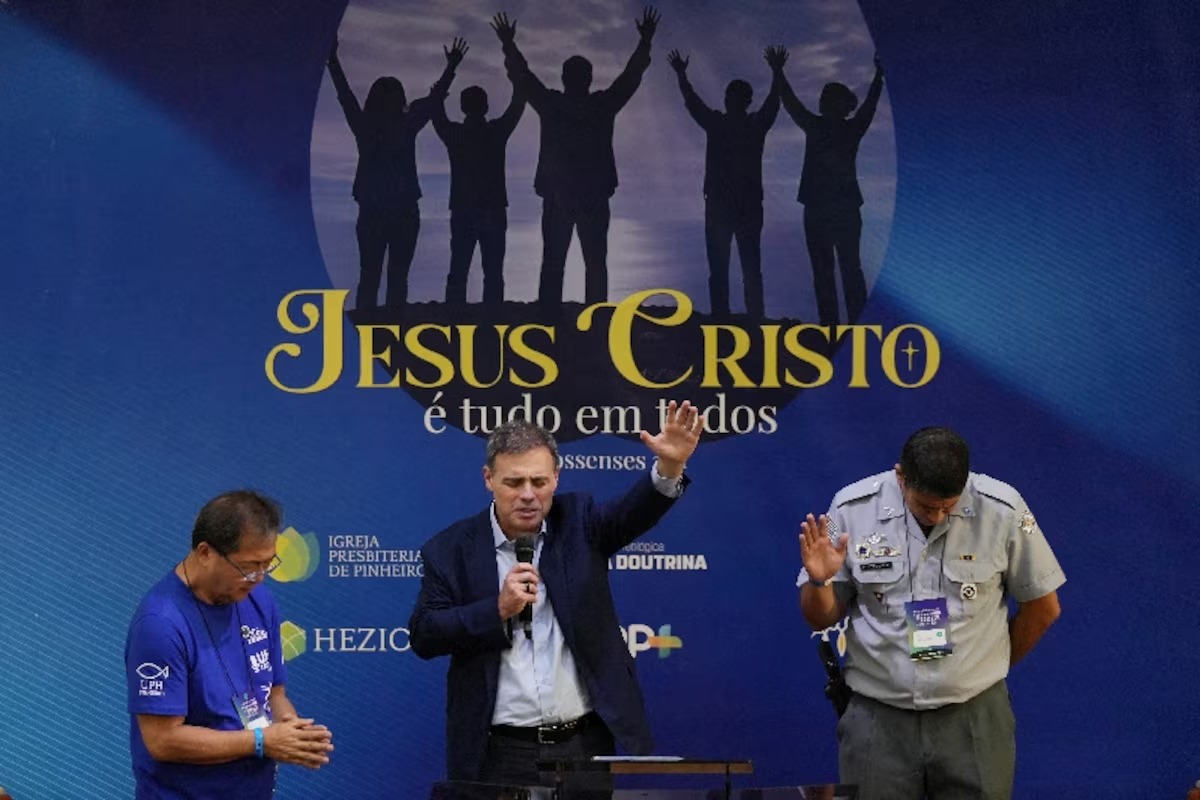
Mendonca’s standing among evangelical conservatives is particularly visible at the church in Sao Paulo where he serves as an assistant pastor.
During a rainy Saturday in late August, around 150 men gathered at the church to hear Mendonca speak about the “Principles of an Upright Leader.”
“An upright leader is someone you can trust,” Mendonca told the congregation.
He left the church early that day to return to Brasilia, where a significant judicial decision awaited him.
Two days earlier, Mendonca had received a police report he had ordered concerning fellow Justice Alexandre de Moraes and allegations surrounding Moraes’ purported role as an adviser to Daniel Vorcaro, the owner of a bank at the center of a multibillion-dollar fraud investigation.
Moraes has become a deeply unpopular figure among Bolsonaro’s supporters because of his pursuit of Jair Bolsonaro in connection with a coup plot that ultimately resulted in the former president’s conviction.
The report concerning Moraes contained messages that allegedly included a possible escape plan sent to him by Vorcaro. Moraes did not respond to a request for comment.
Mendonca subsequently made the report public. Moraes responded by seeking an investigation into Mendonca for alleged abuse of authority, pushing the Supreme Court into an unusually serious internal dispute.
Chief Justice Edson Fachin has attempted to manage the confrontation by giving both justices until Friday to respond to the allegations.
‘A lamb’ and ‘a lion’
For supporters at Mendonca’s church, his growing role in Brazil’s political and judicial turmoil is evidence of a justice guided by principle rather than political allegiance.
Jeronimo Amaral, a 57-year-old lawyer who attended Mendonca’s August sermon, described him as someone who “seeks only the truth, regardless of whom it might hurt.”
During the sermon, Mendonca spoke about the importance of fulfilling a divine purpose, while recounting a conversation he had with Bolsonaro before his nomination to the Supreme Court.
According to Mendonca, Bolsonaro questioned whether someone as calm as him could survive the difficult environment of Brazil’s highest court.
Mendonca recalled responding that there are circumstances when a person must be a “lamb” and others when it is necessary to be a “lion.”
Knowing which role the moment demands, he said, “takes wisdom.”