


BEIJING, Sept 10 — Just days after TianGong Ultra stunned audiences by running 100 metres faster than the long-standing human sprint record, its development team has already shifted attention from speed to something far more difficult: making humanoid robots dependable enough for everyday work.
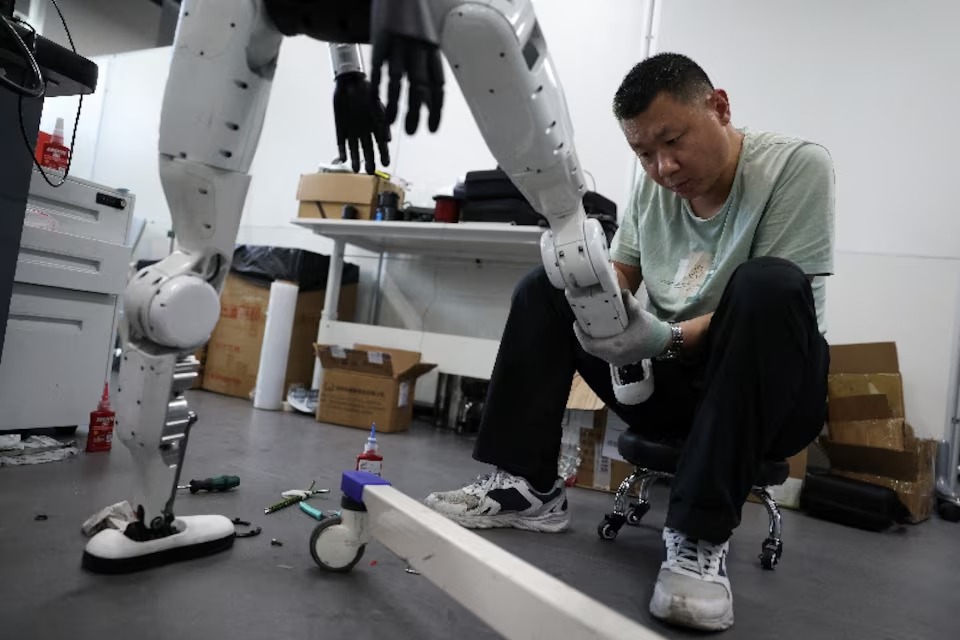
Ultra completed the 100-metre race at the World Humanoid Robot Games in 8.64 seconds, nearly a second faster than Usain Bolt’s world record. The performance followed intensive preparation that saw engineers test, repair and retest their machines around the clock between races.
“When it started smoothly and got past 50 metres, that was when I finally relaxed,” said Jack Guo, the 34-year-old engineer leading development of Ultra and Omni, a smaller humanoid model used in 400-metre races, at the Beijing Humanoid Robot Innovation Centre, known as X-Humanoid.
But for Guo, the record is only a milestone.
“We want to turn high performance into high reliability and high usability,” he said in his first interview with foreign media.
The ambition reflects a broader challenge for China’s rapidly expanding humanoid robotics sector. State support, established manufacturing networks and fierce competition have helped companies make rapid progress in robot mobility. The next test is whether machines capable of spectacular demonstrations can be transformed into practical workers.
INSIDE X-HUMANOID’S WORKSHOP
X-Humanoid is based in Yizhuang, a high-tech development zone in southeastern Beijing that has become one of the country’s important robotics clusters. The area, which has traditionally attracted automakers, now includes a robot sales centre and a restaurant built around the robotics theme as Beijing promotes the sector.
The company’s showroom displays different generations of TianGong robots. Among them is a machine still wearing the vest from a half-marathon victory last year.
On the ninth floor, white Ultra and Omni humanoids hang in metal frames while engineers work on them. One robot has its head cover removed, another is undergoing work on a leg, while others are being put through walking tests. A robot wearing a red “Champion TianGong” headband is a reminder of the recent racing success.
In nearby offices, engineers develop software before transferring it to physical machines for testing.
Founded in November 2023, X-Humanoid is supported by state-owned and private investors, including robotics company UBTech, as well as Chinese technology companies Xiaomi and Baidu. The company works across hardware, motion-control software and artificial intelligence while also developing and commercialising its own humanoid robots.
X-Humanoid has not disclosed the number of its robots sold or deployed commercially.
Its customers include universities, research institutions and companies investigating industrial applications. At Foton Cummins’ engine factory in Beijing, X-Humanoid robots have been tested for moving boxes. The company’s Tianyi 2.0 has lifted boxes weighing between 8 kg and 12 kg onto shelves as part of what the factory described as an early-stage exploration.
FROM RACING TO REAL-WORLD WORK
Ultra’s original purpose was not to win a race. The project began as an effort to test the limits of humanoid movement.
Guo compares the development of humanoid robots with the early automobile industry. The first step, he said, is building machines that can be controlled reliably. The next is combining dependable physical systems with increasingly capable AI “brains” that can independently perform complicated tasks.
For now, however, the priority is the robot itself.
Guo said engineers need to make the body and movement-control system sufficiently stable and reliable for regular use. More sophisticated AI capable of handling complex autonomous tasks will require additional time to develop.
The ability to run is also useful beyond competition. Training a humanoid to move quickly can improve its general mobility and help it deal with different types of terrain.
Omni has already demonstrated one potential application. During an internal test this year, the smaller humanoid climbed from the first floor to the 17th floor of X-Humanoid’s headquarters.
Guo expects smaller humanoids to initially find opportunities in commercial services and light industrial work. Ultra, meanwhile, could eventually be used for outdoor inspection and emergency rescue operations.
Safety remains a major obstacle. Ultra weighs 75 kg and can travel at more than 17 metres per second at top speed, making it difficult to stop quickly. During the robot games, a crash mat was positioned beyond a relatively short run-off zone, meaning some machines in the 100-metre races hit the barrier after completing their sprints.
Future versions could be lighter, capable of stronger braking and designed to adopt safer body positions during deceleration, Guo said.
HOW ULTRA BROKE THE RECORD
Ultra entered the competition with three running strategies developed through simulation. One had already been extensively tested, while the other two offered greater speed potential but had less real-world validation.
Each strategy is a trained motion-control system designed to continuously adjust the robot’s joints and balance, allowing it to run upright without an operator controlling every individual movement.
Ultra used different programs during the three stages of the competition. It recorded 9.39 seconds in the preliminary round, improved to 8.86 seconds in the semifinal and then reached 8.64 seconds in the final.
Between races, engineers returned to their testing facility to push the faster programs further while refining navigation and running controls. Some worked through the night and continued testing into the following day before heading back to the competition.
The aggressive development process came with plenty of failures. Robots pushed to their limits stumbled, lost balance and crashed. Teams sometimes had to bring out backup machines while engineers rushed to repair damaged units.
The failures were even more severe during earlier stages of Ultra’s development.
“Legs broke, waists broke,” Guo said.
A final breakthrough came only shortly before the championship race. On the morning of the final, engineers were still testing a newly trained running program. Although it performed consistently during trials, it failed to deliver the same results on the competition track.
Differences between individual robots also complicated the process, leaving Guo uncertain before the final.
Ultra’s relatively heavy legs hindered its acceleration at the start. But after reaching roughly 10 metres per second, the robot was able to continue building speed and close the gap on its competitors.
Guo estimated that the team had reduced Ultra’s starting response time by about half a second by the semifinal. Once that improvement was achieved, the focus moved increasingly toward maximum speed.
In the final, a quicker start combined with stronger acceleration late in the race helped Ultra make a decisive move past its rivals.
The victory prompted celebrations from the team. At the closing ceremony, several TianGong humanoids appeared in red capes bearing the word “Champion”, with some waving pom-poms.
For Guo, the result finally brought a moment of relief.
“Finally, I could get a good night’s sleep,” he said.