


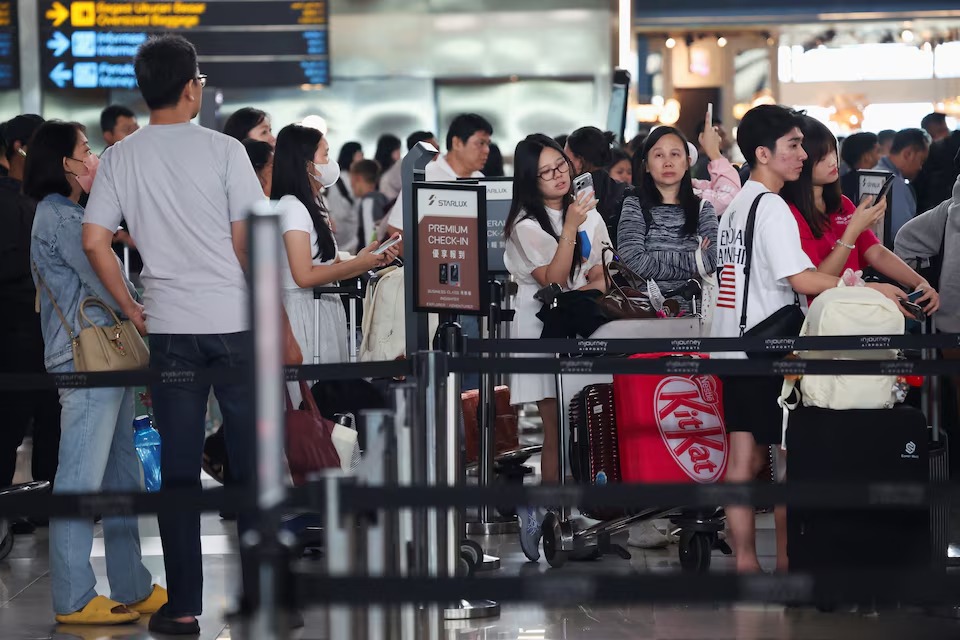
JAKARTA [Agency Report]: Indonesia reopened its main airport in Jakarta and four other airports on Tuesday after volcanic ash from Mount Anak Krakatau disrupted air travel across the region, although renewed eruptions kept the threat of further flight disruptions in focus.
Soekarno-Hatta International Airport, the main gateway serving Jakarta, resumed operations after winds dispersed ash that had affected the airport and surrounding areas. Transport Minister Dudy Purwagandhi said authorities would inspect the airworthiness of 178 aircraft that had remained grounded during the closure before they return to service.
“Perhaps it’ll take some little extra time to prepare the planes,” Dudy said.
The airport shutdowns followed an eruption by Anak Krakatau late Friday. The volcano, located between Indonesia’s Java and Sumatra islands, sent ash over Jakarta and nearby areas, prompting the closure of eight airports on safety grounds and affecting more than 340,000 travellers.
For some passengers, the disruption has already stretched into several days.
Alvin Pratama Putra, 31, arrived at Soekarno-Hatta on Sunday expecting to travel to South Korea for work. His flight was subsequently moved to Thursday, leaving him stranded at the airport.
“What can you do? It’s nature. It’s dangerous for the plane if you force it,” he said, adding that he had spent the night sleeping on an airport bench.
Four additional airports, including another airport serving Jakarta and one in neighbouring Bandung, also resumed operations on Tuesday. A separate airport reopened on Monday, while two airports remained closed.
The disruption is also creating financial pressure for Indonesian airlines. Bayu Sutanto, secretary general of the Indonesia National Air Carriers Association, said carriers were losing income from cancelled flights while simultaneously facing higher operating costs.
Those expenses can include additional fuel caused by route diversions, aircraft parking charges and crew-related costs. Bayu said a delay involving one aircraft at Soekarno-Hatta could have a knock-on effect on the next three or four flights scheduled to use the same plane.
Airlines could face losses of as much as 19 billion rupiah, or about $1 million, for each day of major disruption, he said.
Fresh eruptions keep aviation risks in focus
Anak Krakatau erupted three more times on Tuesday morning, according to Indonesia’s volcano monitoring agency.
The latest eruptions were smaller than the earlier activity, but authorities said aviation could still be affected depending on how high the ash rises and the direction of the wind.
“So far, the impact is not as big as the previous eruptions, but we’ll continue to monitor,” Lana Saria, head of the geological agency, said in a text message.
Indonesia is home to around 130 active volcanoes and lies along the Pacific Ring of Fire, a region marked by intense seismic activity where tectonic plates meet. The country regularly experiences both earthquakes and volcanic eruptions.
Anak Krakatau is not the only volcano showing activity. Mount Ibu and Ili Lewotolok, both located on islands east of Java, also erupted on Tuesday.
The name Anak Krakatau means “child of Krakatau.” The volcano began emerging roughly a century ago from the area once occupied by Krakatau, also known as Krakatoa.
The earlier volcano was destroyed during catastrophic eruptions in 1883. The event triggered a series of tsunamis and killed more than 36,000 people.