


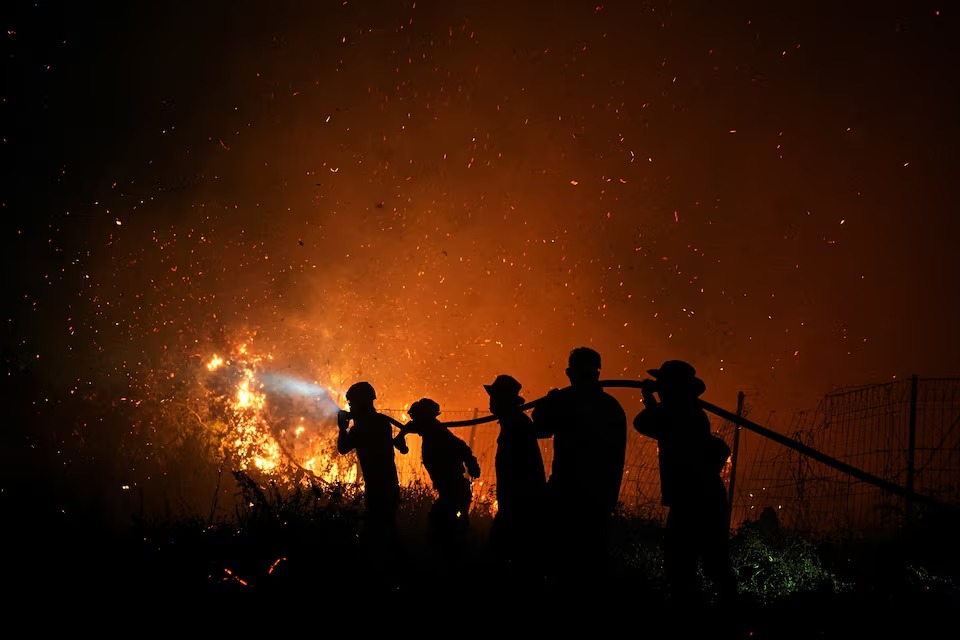
JAKARTA [Ground Report]: Indonesia is experiencing a sharp rise in wildfire emissions as dry conditions fuel fires across forest and peatland areas of Borneo and Sumatra, pushing the country’s carbon dioxide emissions from fires to the highest level globally, according to monitoring data released Wednesday.
Between September 1 and September 7, Indonesian wildfires released an estimated 19.7 million metric tons of emissions, accounting for more than one-third of the global total and surpassing Russia’s emissions for the same period, data from the European Union’s Copernicus climate monitoring system showed.
Indonesia regularly faces extensive fires during the dry season, but the current conditions have been intensified by a strong El Niño pattern. Authorities have described this year’s wildfire season as the country’s most severe in 11 years.
Mark Parrington, a senior scientist with the Copernicus Atmosphere Monitoring Service in Bonn, said El Niño was significantly amplifying the seasonal fire activity.
“We do expect to see some fires across the region at this time of year, but with El Niño, it clearly just gives a big enhancement to them,” Parrington said.
“It’s much drier, it’s hotter, and when there’s ignition, these fires burn in a far more extreme way.”
Copernicus data showed that fire emission intensity in Indonesia exceeded 1,500 kilograms per square kilometre during the first week of September. That was more than 10 times the corresponding level recorded in Russia. The most intense activity was concentrated in Kalimantan, Indonesia’s portion of Borneo, as well as eastern Sumatra.
Emissions during the week were 273% above the seasonal average. However, they remained below the 21.7 million metric tons recorded during the equivalent period in 2015, another year marked by severe El Niño conditions.
The deteriorating conditions have also affected air quality. In Pontianak, the capital of West Kalimantan, the air quality index reached 394 on Wednesday, according to Swiss monitoring company IQAir. An index reading above 300 is classified as hazardous.
Indonesia’s environment ministry said it was concerned about hazardous air quality readings reported in Kalimantan and other areas. The ministry said it was monitoring Copernicus data, while cautioning that fire-emission estimates do not directly represent air quality conditions in a particular location and must be assessed alongside other factors.
Fires expand sharply
The scale of the fires has increased significantly as the dry season has progressed.
From January through July, approximately 202,000 hectares of Indonesian land were affected by fires, according to Nisa Novita of environmental group YKAN, which works with communities on fire prevention and response. That figure was about one-third of the area burned during the same period in 2015.
Novita said preliminary estimates indicated that August could add roughly 600,000 hectares to the total, particularly across Kalimantan, Sumatra and South Papua.
The scale of the 2015 disaster provides a stark comparison. Indonesia lost about 2.6 million hectares to fires that year, an area larger than Wales.
Satellite-based monitoring also points to an unusually active fire season. Indonesia’s Sipongi forest monitoring platform recorded 13,443 hotspots between August 1 and September 8, compared with 9,454 during the corresponding period in 2015. The figures are based on observations from NASA’s Terra and Aqua satellites.
Sipongi recorded its highest monthly number of hotspots in October 2015.
Fire emissions may be underestimated
The emissions estimates from Fire Emissions Watch are based on satellite observations that track particulate matter, volatile organic compounds, greenhouse gases and other pollutants generated by fires.
But the monitoring system may not capture the full scale of Indonesia’s peat fires, according to Parrington. Fires that burn at low temperatures or beneath the surface can remain undetected by satellite sensors.
“One of the aspects with peat fires is if they’re burning at low temperatures or underground, they’d be below the detection limit of the sensors, which means we’re not actually seeing them,” he said.
Indonesia’s severe fire seasons have previously produced significant environmental and health consequences. Research into the 2015 fires found that daily emissions exceeded those produced across the European Union, while the resulting pollution was associated with more than 100,000 excess deaths across Indonesia, Malaysia and Singapore.
With the current fire season still in its early stages, scientists are warning that emissions could continue rising in the weeks ahead.
“We have to remember that this is still the beginning of the season, and we expect the fires to continue and the emissions to keep increasing, potentially through to the end of October, which is what we saw in 2015,” Parrington said.
He added that the full severity of this year’s fire season would become clearer over the next two months, while early indicators suggest activity is already matching or slightly exceeding levels seen during previous strong El Niño years.