


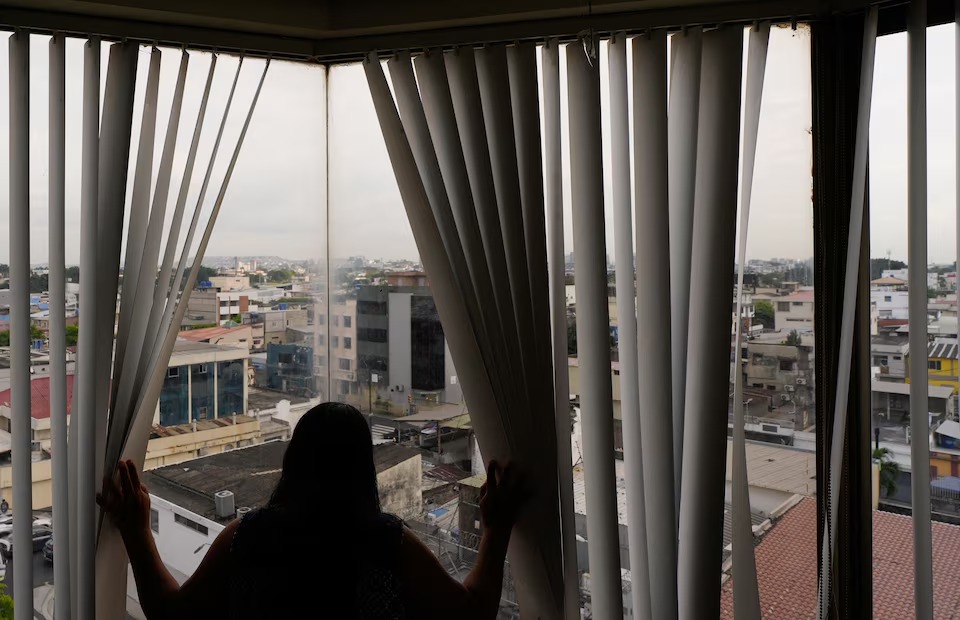
GUAYAQUIL/QUITO, Ecuador [Business Emerge]: A surge in gang warfare across Ecuador is forcing hundreds of thousands of people to abandon their homes, as criminal groups tighten their grip on neighborhoods through killings, extortion, threats and forced recruitment.
In Guayaquil’s Nueva Prosperina district, one 66-year-old grandmother said she finally decided to leave after bullets began striking the rooftops of the housing development where she had lived for almost two decades.
She feared for her daughter, who travels to work by motorcycle, and for her teenage grandson, who she worried could be pressured into joining a criminal group. Armed factions, she said, increasingly treated residents and visitors as potential members of rival gangs.
“It was a terrible situation. Bullets were hitting the rooftops and that made me leave,” she said.
The woman is among more than 300,000 people who have been displaced within Ecuador during the past three years because of violence, including death threats, extortion, criminal recruitment and the killing of relatives, according to figures from the UN Refugee Agency and Ecuador’s Ombudsman’s Office. Human rights advocates believe the actual number may be considerably higher.
Ecuador was once viewed as one of Latin America’s safer countries. It now has the region’s third-highest level of internal displacement, behind Haiti and Colombia, according to the Norwegian Refugee Council.
The crisis has intensified as Ecuador has become a major transit route for illegal drugs. President Daniel Noboa, who took office in 2023, pledged to restore security through a forceful campaign against organized crime.
But the crackdown has also contributed to a fragmented criminal landscape, according to the Permanent Committee for the Defense of Human Rights in Guayaquil. The arrests and deaths of gang leaders have weakened established networks and triggered battles among splinter groups competing for territory.
Ecuador registered 9,216 violent deaths last year, equivalent to a homicide rate of 51 per 100,000 people. That was roughly eight times the rate recorded a decade earlier and significantly above the 2025 rates reported by authorities in Mexico, at 21.4 per 100,000, and Colombia, at 25.8.
The government maintains that its security campaign is producing results. It says killings declined by 8% between January and July this year compared with the same period in 2025, while arguing that the majority of those killed are connected to criminal gangs.
FREE INSIDE OUR HOMES
For residents who remain, extortion has become one of the most pervasive tools of gang control.
Police and the Ombudsman’s Office say criminal organizations use threats and demands for money systematically across Ecuador. In Nueva Prosperina, local police estimates suggest that about half of families have experienced some form of extortion.
“A WhatsApp message has almost the same impact as a bomb,” said Francesco Volpi of the Norwegian Refugee Council, describing the intimidation as indiscriminate.
A 45-year-old shopkeeper said he left Nueva Prosperina after gangs threatened his children in an effort to recruit them. He also described being intimidated by people he believed were police officers.
District police chief Gino Pillajo said several individuals had been detained for allegedly posing as police officers. He acknowledged that many extortion cases never reach the authorities because victims fear retaliation.
Police have sought information through community leaders and introduced QR codes at local businesses so residents can report incidents anonymously. Officers also accompany families when they leave their homes, both to provide protection and to identify properties that have been abandoned.
The displacement crisis extends well beyond Guayaquil.
Indigenous Chachi communities close to Ecuador’s border with Colombia have temporarily left their territories after threats from illegal miners, according to the Ombudsman’s Office. In Babahoyo, businesses in Los Rios province are closing earlier to reduce exposure to violence. In Sucumbios, in the Amazon region, some families have abandoned their land amid fears that criminal organizations will persuade young people to join them.
The government has acknowledged the displacement problem, but officials have said there is uncertainty over which state institution should take responsibility for addressing forced displacement caused by violence.
Billy Navarrete, who heads the Guayaquil human rights committee, said the absence of formal legal recognition has made it harder to protect victims and coordinate assistance.
“There is no legal recognition of internal forced displacement caused by violence, and that means the phenomenon is not discussed, no action is taken to protect victims, and no mechanisms are created to monitor and assist affected communities,” Navarrete said.
For displaced families, finding somewhere safe to go is often difficult. Some move in with relatives in other neighborhoods, while others leave their cities altogether. Families without financial resources, alternative accommodation or support networks may have little choice but to remain in areas controlled by criminal groups.
One 49-year-old resident described a life in which silence has become a form of survival. She said gangs have used the neighborhood to conceal kidnapping victims, prohibited community gatherings and checked residents’ mobile phones for signs of connections to rival groups.
“We have to stay silent. We are silent accomplices. We can’t say anything because our lives are at risk,” she said.
Her description of life under gang control was stark: “We are free inside our homes, but outside we are prisoners.”
“They make the rules. If they don’t want you there, they throw you out,” she said.